Thursday, October 3, 2013

OCTOBER NIFTY OPTIONS - RAJKAMALSTOCKOPTIONS


OCTOBER NIFTY OPTIONS - RAJKAMALSTOCKOPTIONS
NIFTY OPTION DATE ENTRY SL TAR`1 TAR`2 CLOSE CALL P / L - 5 LOTS
NIFTY 5800 CALL 1/10/2013 165 150 175 195 180 3750-00
BANKNIFTY 10500 CALL 3/10 285 260 350 450 330 5625-00


Wednesday, October 2, 2013

Why the Health Care Law Scares the G.O.P.

Why the Health Care Law Scares the G.O.P.

Economic Scene

Eduardo Porter writes the Economic Scene column for the Wednesday Business section.

The business lobbying group had not suddenly gone rogue. Here is how Daniel P. Mehan, its president, summarized his feelings about President Obama’s health care law: “We don’t like it.” 
 
But the Chamber was cognizant of the plea of its members directly affected by the issue: dozens of Missouri hospitals stood to lose $4.2 billion over six years in federal support for uncompensated care if the state refused to increase the income ceiling for Medicaid eligibility. 
 
Pragmatism suggested accepting the expansion. Washington would pay the extra cost entirely for three years and pick up 90 percent of the bill thereafter. 

And it would expand health coverage in the state’s poor, predominantly white rural counties, which voted consistently to put Republican lawmakers into office. 

Missouri’s Republican-controlled Legislature — heavy with Tea Party stalwarts — rejected Medicaid’s expansion in the state anyway. 

After their vote, a frustrated editorial in the faithfully conservative Missourian asked of the state’s elected Republicans: “Who Do They Represent?” 

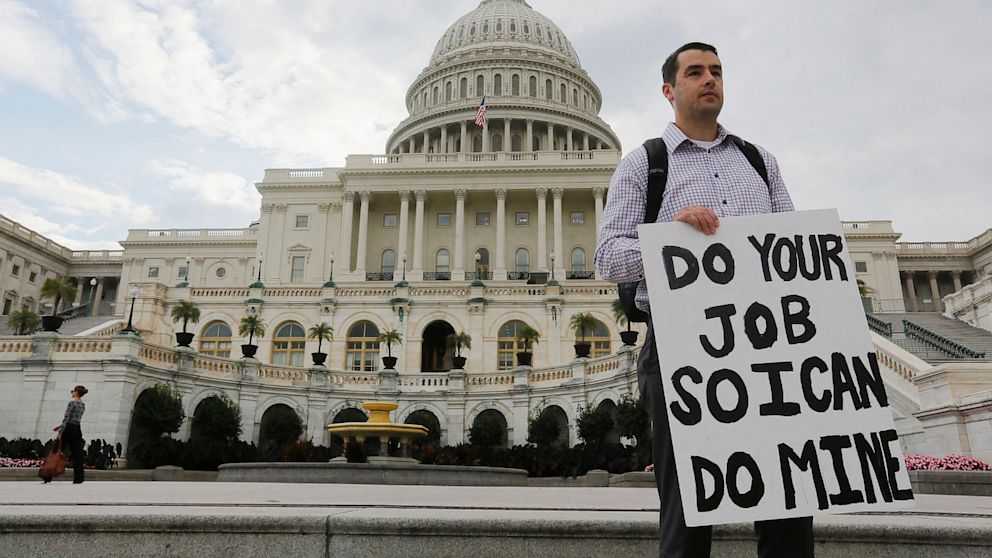
Today, the same forces that blocked the expansion of Medicaid in Missouri are going all out in Washington in a bid to undo all of the Affordable Care Act. Bowing to the vehemence of its Tea Party faction, the House G.O.P. forced a government shutdown when Senate Democrats refused to delay or defund the president’s health overhaul. 
 
House Republicans are threatening even further damage if they don’t get their way, possibly unleashing financial chaos if they manage to force the United States into its first default ever on the government’s debt.
Republicans’ efforts raise the same perplexing question posed by the Missourian: What drives Tea Party Republicans and their financial backers? What calculation persuades them that repealing the health care law is worth the risk? Indeed, whose interests do they represent? 

Nearly 6 in 10 Americans disapprove of trying to stop the law by cutting its financing. Even among those who don’t like the law, less than half want their representatives in Congress to try to make it fail. 

It is tempting to discard the Tea Party activists driving the Republican Party as crazy — as some commentators have — motivated by fear and willing to believe that default won’t cause much harm and might even act as a purgative to free the economy of a bloated government. 

“They listen to nobody but themselves,” the Harvard political scientist Theda Skocpol told me. “They are convinced of their rectitude and convinced that they alone are qualified to save America from the dire threat of Obama and his polices. They have worked themselves into a dangerous place.” 

Their relationship with reality can take peculiar turns. Reflexive opponents of “government,” they can exhibit little sense of what the government actually does. 

And yet the argument that half the Republican Party has simply lost its mind has to be an unsatisfactory answer, especially considering the sophistication of some of the deep-pocketed backers of the Tea Party insurgency. 

There is a plausible alternative to irrationality. Flawed though it may turn out to be, Obamacare, as the Affordable Care Act is popularly known, could fundamentally change the relationship between working Americans and their government. This could pose an existential threat to the small-government credo that has defined the G.O.P. for four decades. 

The law is imperfect. It has dozens of complicated, interlocking parts. Half of Americans say they don’t understand how it will affect them and their family. Still, the law has many provisions that are likely to improve life for millions of Americans, including a big portion of what we know as the working middle class.
Almost two-thirds of uninsured Americans have a full-time job, according to the Kaiser Family Foundation. A further 16 percent are employed part time. 

The Department of Health and Human Services recently estimated that nearly six in 10 uninsured Americans could qualify for health coverage in the insurance market for less than $100 per person per month. 

According to an analysis by the Urban Institute, 28 million Americans would gain health insurance under Obamacare. Of these, eight million earn more than twice the poverty level of $47,100 for a family of four. A majority of those would get a subsidy to buy a plan. 

As it turns out, the core Tea Party demographic — working white men between the ages of 45 and 64 — would do fairly well under the law. 

Take Missouri. It has about 800,000 uninsured. Almost half of them would have been eligible for expanded Medicaid benefits, had the Legislature not rejected them. Many of the rest — including families of four making up to $94,000 — will be eligible to get subsidized health insurance. 

In St. Louis, for instance, a family of four making $50,000 a year will be able to buy a middle-of-the-road “silver” health plan for $282 a month and a bottom-end “bronze” plan for $32. Even Medicare recipients will get a benefit worth a few hundred dollars a year. 

This could justify conservative Republicans’ greatest fears. 

In 1994, when President Bill Clinton took an earlier stab at a health care overhaul, the conservative thinker William Kristol published a manifesto about why Republicans had to stop it. 

“Passage of the Clinton health plan in any form would be disastrous,” Mr. Kristol wrote, italicizing for emphasis. “It would guarantee an unprecedented federal intrusion into the American economy. Its success would signal the rebirth of centralized welfare-state policy at the moment that such policy is being perceived as a failure in other areas.” 

Two decades after Mr. Clinton’s ultimately failed attempt, Obamacare poses the same sort of threat. 

Even Americans who say they dislike the law actually like many of its components. Nearly three-quarters approve of giving financial help to poor and moderate-income Americans to buy health insurance. 

Two-thirds approve of barring insurance companies from denying coverage because of somebody’s medical history. Three-quarters favor letting children stay on their parents’ insurance until they are 26. 

Until now, social welfare programs in the United States have exhibited a “big hole,” Professor Skocpol said, consisting of nonpoor working-age Americans and their children. Obamacare closes a big chunk of it. 

“The main beneficiaries tend to have lower wages, employed in smaller businesses that are not providing health insurance,” she said. “They are not elderly. They are also not the poorest.” 
 
And they might be grateful to Democrats for the benefit. 

To conservative Republicans, losing a large slice of the middle class to the ranks of the Democratic Party could justify extreme measures. 

E-mail: eporter@nytimes.com;

US STOCKS-Wall St falls on second day of government shutdown

US STOCKS-Wall St falls on second day of government shutdown

Wed Oct 2, 2013 10:06am EDT


* Government shutdown enters second day; no end in sight
* ADP report shows fewer jobs added in Sept than expected
* Monsanto drops after fourth-quarter loss, lower outlook
* Indexes down: Dow 0.7 pct, S&P 0.6 pct, Nasdaq 0.4 pct
By Ryan Vlastelica
 
NEW YORK, Oct 2 (Reuters) - U.S. stocks fell on Wednesday as a partial government shutdown in Washington entered a second day, adding to concerns over how soon a political compromise would be reached.

There were few signs that Congress was making progress in agreeing on a spending bill that would reopen operations. The Democratic-led U.S. Senate voted Tuesday to kill Republicans' latest attempts to modify an emergency funding bill, and sent a "clean" measure back to the House of Representatives that would extend funding for government agencies until Nov. 15.

Up to 1 million government workers remained on unpaid leave Wednesday as a result of the closure, with a fight over President Barack Obama's healthcare law at the center of the impasse.
 
Market participants are also watching the situation for an indication of how an impending debate on the debt ceiling might play out. That issue is considered far more important for the economy, as it could result in an unprecedented debt default if not passed.

U.S. Treasury Secretary Jack Lew said late Tuesday the Treasury had started using its final tools to push back the date of when the government will run out of legal borrowing authority.

"We hope they can resolve it and also make progress on negotiating the debt ceiling, but no one knows for sure. So the market is left to swing from bouts of optimism like we saw yesterday, to bouts of pessimism today," said Bruce McCain, chief investment strategist at Key Private Bank in Cleveland, Ohio.

The shutdown's impact on economic growth and market volatility will likely increase the longer it continues.
 
McCain estimated that if the shutdown were to last 21 days, as the previous one did, "that would trim a quarter of the 2.5 percent annualized growth rate we saw last quarter. That isn't an insurmountable hurdle, but it would hurt."

All ten S&P 500 sectors were lower, with material stocks the weakest, off 0.8 percent. Chemical maker OM Group fell 4.1 percent to $32.68 while Alcoa Inc lost 2.2 percent to $7.99. Alcoa was also pressured by a downgrade by Deutsche Bank.

The Dow Jones industrial average was down 105.77 points, or 0.70 percent, at 15,085.93. The Standard & Poor's 500 Index was down 9.75 points, or 0.58 percent, at 1,685.25. The Nasdaq Composite Index was down 15.31 points, or 0.40 percent, at 3,802.67.

Equities have been volatile recently, with the CBOE Volatility index spiking more than 25 percent over the past two weeks. However, the S&P has found support at its 50-day moving average of 1,679.78.

Wall Street has managed to avoid steep declines during similar federal government closures in the past.
 
During a shutdown from Dec. 15, 1995 to Jan. 6, 1996, the S&P 500 added 0.1 percent. During the Nov. 13 to Nov. 19, 1995, shutdown, the benchmark index rose 1.3 percent.

Data released Wednesday by a payrolls processor showed U.S. private employers added 166,000 jobs in September, below expectations for 180,000 jobs. Investors may place more weight than usual on the report as government data will not be released during the shutdown. Friday's key payroll report will be delayed if no deal is reached by then.


Monsanto Co reported a fourth-quarter loss that was wider than expected, and offered a reduced outlook for 2014 even as it said it was positioned for strong growth next year. Shares fell 2.7 percent to $102.21.

Nation remembers Gandhi on birth anniversary - 2nd OCTOBER

Nation remembers Gandhi on birth anniversary

PTI  New Delhi, October 02, 2013
First Published: 15:40 IST(2/10/2013) | Last Updated: 15:42 IST(2/10/2013)

Nation on Wednesday remembered Mahatma Gandhi on the occasion of his 144th birth anniversary with top leaders paying floral tributes at his memorial in New Delhi.
 
President Pranab Mukherjee, vice-president Hamid Ansari, Prime Minister Manmohan Singh, Congress president Sonia Gandhi and senior BJP leader LK Advani were among prominent leaders who payed homage to Father of the Nation.

The Congress president was the first to arrive at Rajghat to pay tributes to Mahatma Gandh followed by BJP leader LK Advani and his daughter Pratibha.
 
After a while, the Prime Minister arrived at Rajghat and paid floral tributes to the Father of the Nation.
Singh and Sonia greeted each other with folded hands. Parliamentary affairs minister Kamal Nath and Delhi chief minister Sheila Dikshit were seated between them.
 
Other dignitaries who visited Rajghat include women and child development minister Krishna Tirath, parliamentary affairs minister Kamal Nath, senior Congress Leaders Mani Shankar Aiyar and Manikrao H Gavit, Delhi chief minister Sheila Dikshit among others.

An all-religion prayer was conducted during the ceremony. The favourite hymns of Gandhi were also played on the occasion.

Favourite Hymns of Gandhi:

Here Is Thy Footstool
Here is thy footstool and there rest thy feet where live the
poorest and lowliest and lost.
When I try to bow to there, my obeisance cannot reach down to the depth where thy feet rest among the poorest and lowliest and lost.
Pride can never approach to where thou walkest in the
clothes of the humble among the poorest, and lowliest and lost.
My heart can never find its way to where thou keepest
company with the companionless among the poorest, the lowliest and the lost.
-Gitanjali, No.10
Source: Gandhi- The Writer by Bhabani Bhattacharya
 
From the Ramcharitamanas of Tulsidas
Grant me, O Master, by Thy grace
To follow all the good and pure:
To be content with simple things;
To use my fellows not as means but ends:
To serve them stalwartly, in thought, word, deed;
Never to utter word of hatred or of shame:
To cast away all selfishness and pride:
To speak no ill of others:
To have a mind at peace,
Set free from care, and led astray from Thee
Neither by happiness nor by woe:
Set Thou my feet upon this path,
And keep me steadfast in it,
Thus only shall I please Thee, serve Thee right.
Source: Gandhi- The Writer by Bhabani Bhattacharya
 
From the Ramcharitamanas of Tulsidas
This and this alone
Is true religion-
To serve Thy brethren:
This is sin above all other sin,
To harm Thy brethren:
In such a faith is happiness,
In lack of it is misery and pain:
Blessed is he who swerveth not aside
From this straight path:
Blessed is he whose life is lived
Thus ceaselessly in serving God:
By bearing others' burdens,
And so alone,
Is life, true life, to be attained:
Nothing is hard to him who, casting self aside,
Thinks only this-
How may I serve fellow-men?
Source: Gandhi- The Writer by Bhabani Bhattacharya
 
Vaishnov Jan to
Vaishnov Jan to taynay kahyeeye
Jay peerh paraaye janneyray
Par dukkhey upkar karey teeyey,
man abhiman na anney ray

Sakal lokma Sahuney bandhey,
Ninda Na karye kainee ray
Baach kaachh, Man nischal Raakhey,
dhan-dhan jananee tainee ray

Samdrishi nay trishna tyagee,
par-stree jaynay mat ray
Vivihva thaki asatya na bolay,
par-dhan nav jhaley haath ray

Moh maaya vyaayey nahin Jeynay,
dridth vairagya jana manma ray
Ram-nam-shoom taalee laagee,
Sakal teerth seyna tanma ray

Vanloohee nay kapat rahit chhay,
Kaam, Krodh nivarya ray
Bhane Narsinhyo tainoo darshan karta
kul ekotair taarya re.
 
Vaishnov Jan to : It's meaning translated by Khuswant Singh in English:
A godlike man is one,
Who feels another’s pain
Who shares another’s sorrow,
And pride does disdain.

Who regards himself as the lowliest of the low,
Speaks not a word of evil against any one
One who keeps himself steadfast in words, body and mind,
Blessed is the mother who gives birth to such a son.

Who looks upon everyone as his equal and has renounced lust,
And who honours women like he honours his mother
Whose tongue knows not the taste of falsehood till his last breath,
Nor covets another’s worldly goods.

He does not desire worldly things,
For he treads the path of renunciation
Ever on his lips is Rama’s holy name,
All places of pilgrimage are within him.

One who is not greedy and deceitful,
And has conquered lust and anger
Through such a man Saint Narsaiyon has a godly vision,
Generations to come, of such a man, will attain salvation
 
The nation also remembered former prime minister Lal Bahadur Shastri on his 109th birth anniversary.

President, vice-president, Prime Minister, Sonia Gandhi, Advani also paid floral tributes to Shastri, who gave the slogan 'Jai Jawan, Jai Kisan', at his memorial at Vijay Ghat.

Lal Bahadur Shastri
 
Lal Bahadur Shastri was the second Prime Minister of the Republic of India and a leader of the Indian National Congress party. Shastri joined the Indian independence movement in the 1920s


Shastri's sons Anil Shastri and Sunil Shastri were also present at the ceremony.

Tuesday, October 1, 2013

US government shutdown to hit exports: India Inc

US government shutdown to hit exports: India Inc

PTI    New Delhi   Last Updated: October 1, 2013  | 00:00 IST
STORY TOOLS
US govt shutdown to hit exports: India Inc
Indian industry bodies have said the shutdown of the US government after the Republicans and the Democrats failed to strike a deal on spending and budget is bound to hit Indian exports.

The US government on Tuesday shut down - for the first time in nearly 18 years - as the Republican and the Democrats failed to strike a deal on spending and budget mainly due to their differences over 'Obamacare', the flagship healthcare programme of President Barack Obama.

With neither side blinking, despite last minute hectic efforts from both side, the White House immediately ordered the federal government agencies to begin shutting down, furloughing thousands of workers and curtailing some services for the first time since 1995-96.

"The shutdown of the US government will certainly hit Indian exports because of crippling of the trade facilities at the ports and airports," Assocham President Rana Kapoor said.

America is literally too big to fail for the rest of the world, whether we like it or not, he added.

Shutdown means that national parks will close, most routine food inspections will be suspended, paperwork will slow at government offices and many federal employees will be furloughed.

"It is not only in India but also in America that political parties are polarised to extreme positions to the detriment of the common people, industry, trade and business," Kapoor said.

Only emergency and essential services will be able to operate, as a result of which lakhs of government employees would not receive their salary for the shutdown duration.

"The shutdown is a very bad development for Indian exporters who will face problems while doing business transactions. Trade facilitation activities like ports, cargo, regulatory clearances may get affected and result in holding up the landed cargo there," engineering exports body EEPC India said.

Moreover, in the absence of the essential trade facilitation, buyers may put on hold the new orders. The US is among the top buyers of Indian goods and services, it added.

"The shutdown has come at a time when Indian exports were showing some signs of recovery and there were indications of the American economy shaping up again after five years of struggle following Lehman Bros collapse in 2008," EEPC said.

US begins shutdown amid budget row

US begins shutdown amid budget row

What does shutdown mean for two million federal employees, agencies and tourist destinations?
The US government has begun a partial shutdown after the two houses of Congress failed to agree a new budget.
The Republican-led House of Representatives insisted on delaying President Barack Obama's healthcare reform - dubbed Obamacare - as a condition for passing a bill.
More than 800,000 federal employees face unpaid leave with no guarantee of back pay once the deadlock is over.
It is the first shutdown in 17 years and the dollar fell early on Tuesday.
Goldman Sachs estimates a three-week shutdown could shave as much as 0.9% from US GDP this quarter.

“Start Quote

The Republican leadership looks and feels trapped - they made demands that they knew wouldn't be met rather than be accused of weakness and betrayal by their own hardliners”
The White House's budget office began notifying federal agencies to begin an "orderly shutdown" as the midnight deadline approached.
Shortly after midnight, President Obama tweeted: "They actually did it. A group of Republicans in the House just forced a government shutdown over Obamacare instead of passing a real budget."

House Speaker John Boehner told reporters he hoped the Senate would agree to a bipartisan committee known as a conference "so we can resolve this for the American people".
"The House has voted to keep the government open but we also want basic fairness for all Americans under Obamacare," he said.
The Senate is to meet again at 09:30 (13:30 GMT) on Tuesday.
The BBC's Mark Mardell in Washington says the divide in US politics has grown so bitter that government itself cannot function.
Who is affected?
Who will be affected
  • State department will be able to operate for limited time
  • Department of defence will continue military operations
  • Department of education will still distribute $22bn (£13.6bn) to public schools, but staffing is expected to be severely hit
  • Department of energy - 12,700 staff expected to be sent home, with 1,113 remaining to oversee nuclear arsenal
  • Department of health and human services expected to send home more than half of staff
  • The Federal Reserve, dept of homeland security, and justice dept will see little or no disruption
  • US Postal Services continue as normal
  • Smithsonian institutions, museums, zoos and many national parks will close
Democrats were never likely to make concessions on healthcare reform - Mr Obama's signature achievement and a central issue in last year's presidential election, our correspondent says.
 

Timeline: US budget crisis

  • 20 September: House votes to scrap funding for Affordable Care Act ("Obamacare")
  • 30 September: Congress passes two budget bills coupled to Obamacare, both rejected by Senate
  • 1 October: Key provisions of Obamacare come into force despite shutdown
  • 17 October: Deadline for extending government borrowing limit, or debt ceiling
But Republicans have made demands that they knew would not be met rather than be accused of weakness and betrayal by their own hardliners, he adds.
On Monday afternoon, the Democratic-led Senate voted 54-46 against a bill from House Republicans that would have funded the government only if President Obama's healthcare law was delayed for a year.
Major portions of the healthcare law, which passed in 2010 and has been validated by the US Supreme Court, are due to take effect on Tuesday regardless of whether there is a shutdown.
President Obama went on national television to criticise Republicans for trying to refight the last election.
Engineers with the US Navy talk to the BBC about what they will do during a shutdown: Make skis
A shutdown would have "a very real economic impact on real people, right away," he said, adding it would "throw a wrench" into the US recovery.
"The idea of putting the American people's hard-earned progress at risk is the height of irresponsibility, and it doesn't have to happen."

“Start Quote

For all the talk of the rise and rise of China, the US remains the biggest and most important economy in the world.”
After the Senate vote, the chamber's Democratic majority leader blamed Republicans for the imminent halt to all non-essential government operations.
"It will be a Republican government shutdown, pure and simple," said Harry Reid, referring to the Republicans as "bullies".
Mr Obama has signed legislation ensuring that military personnel would be paid. The defence department had advised employees that uniformed members of the military would continue on normal duty, but that large numbers of civilian workers would be told to stay home.
Under the shutdown, national parks and Washington's Smithsonian museums will close, pension and veterans' benefit cheques will be delayed, and visa and passport applications will go unprocessed.
John Boehner: "I hope the Senate accept our offer"
Programmes deemed essential, such as air traffic control and food inspections, will continue.
The US government has not undergone a shutdown since 1995-96, when services were suspended for a record 21 days.
Republicans demanded then-President Bill Clinton agree to their version of a balanced budget.
As lawmakers grappled with the latest shutdown, the 17 October deadline for extending the government's borrowing limit looms even larger.
Democrat Jim McGovern to Republicans: "You own this"
On that date, the US government will reach the limit at which it can borrow money to pay its bills, the so-called debt ceiling.
House Republicans have also demanded a series of policy concessions - including on the president's health law and on financial and environmental regulations - in exchange for raising the debt ceiling.
"I'm thoroughly disgusted with our politicians," Ken Griffith from Kentucky told the Associated Press news agency.
"They're acting like a bunch of three year old children. It's who can hold their breath the longest."

OCTOBER STOCKOPTIONS - RAJKAMALSTOCKOPTIONS


OCTOBER STOCKOPTIONS - RAJKAMALSTOCKOPTIONS
STOCK DATE STRIKE ENTRY TAR1 TAR2 SL CLOSED CALL P/L-2LOTS
RCOM `1/10 170 CALL 3.5 4.2 4.8 3 EXIT COST  
RANBAXY `1/10 360 CALL 19.5 25   17 23 3500-00
KTKBANK `1/10 85 CALL 6.5 7.5 8.5 6 EXIT COST  


NIFTY OPTIONS PERFORMANCE - OCTOBER

NIFTY OPTIONS PERFORMANCE:


OCTOBER NIFTY OPTIONS - RAJKAMALSTOCKOPTIONS
NIFTY OPTION DATE ENTRY SL TAR`1 TAR`2 CLOSE CALL P / L - 5 LOTS
NIFTY 5800 CALL 1/10/2013 165 150 175 195 180 3750-00